
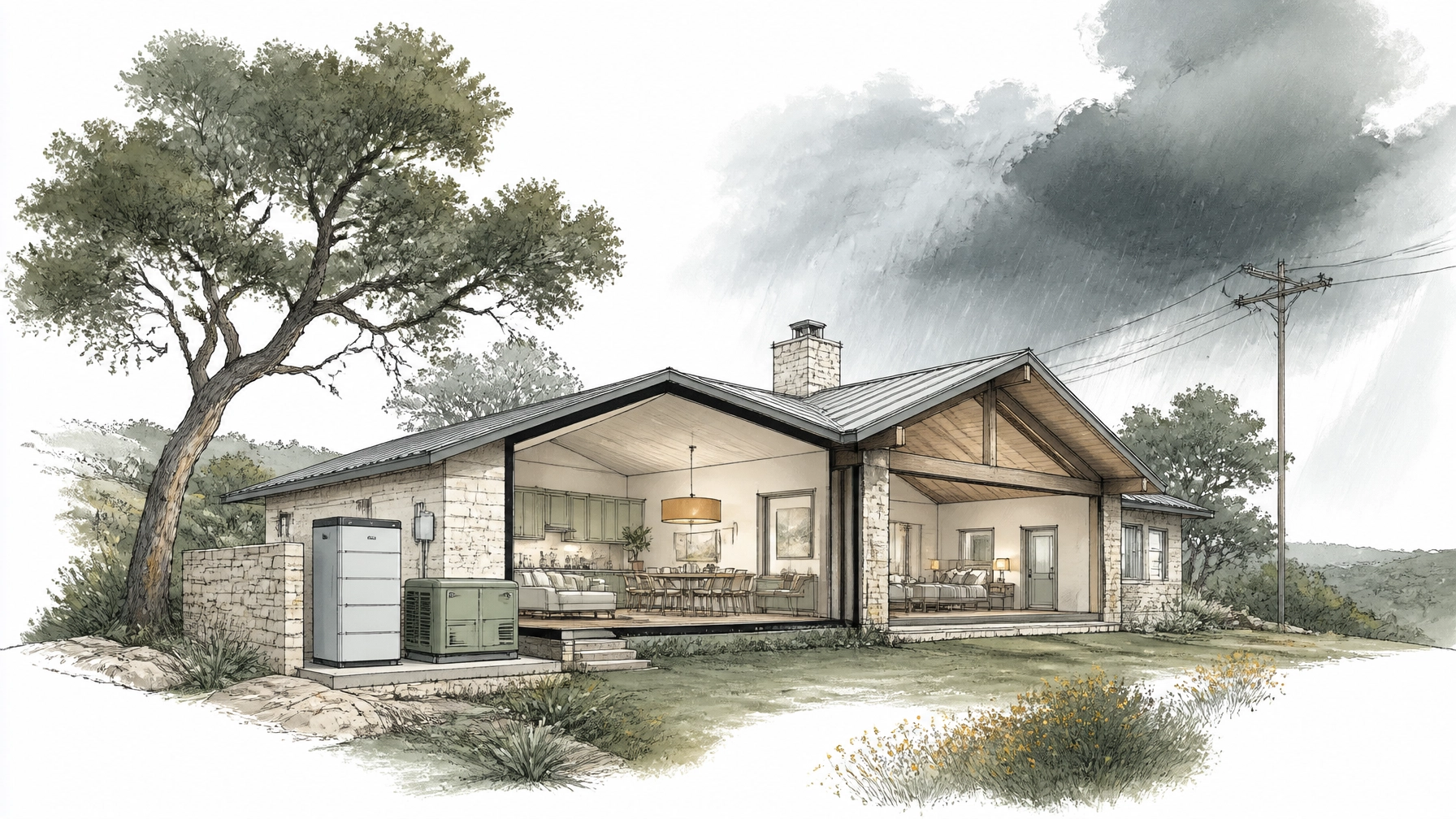
Wimberley offers a slower pace, wide-open views, and the kind of quiet many retirees hope to find in the Texas Hill Country. Rural living also requires a little more advance planning.
A power interruption can affect more than the lights. It may stop a well pump, interrupt internet service, disable a medical device, affect refrigeration, or make it harder to receive weather alerts. The goal is not to make a home immune to every disruption. The goal is to create a home that remains safe, functional, and connected when services are temporarily unavailable.
A resilient Wimberley home typically has four layers:
- A safe and dependable electrical system
- Backup power for essential household functions
- More than one way to connect to the internet
- A simple communications and storm-response plan
This planning is especially valuable for retirees who want their home to support independence for many years.
Start with the systems your household cannot do without
Before choosing a generator, battery, or internet provider, make a list of the services that matter most.
For many Wimberley households, the list may include:
- Refrigerator and freezer
- Well pump and pressure system
- Heating and cooling for a designated room or zone
- Medical equipment
- Modem, router, and phone chargers
- A few lights and electrical outlets
- Security, fire, and medical alert systems
- Garage or gate access
- Sump pumps or other property-specific equipment
This is different from asking, “How do I power the entire house?” A more useful question is, “What must remain available for our safety and comfort?”
The answer will vary by property. A home with a private well, workshop, pool, guest house, or extensive acreage may have very different electrical demands from a compact retirement cottage.
If you are still evaluating whether a rural move fits your lifestyle, our guide on what urban retirees discover when moving to Wimberley can provide broader context.
Have the electrical system reviewed before adding backup equipment
Backup power works best when the home’s electrical system is understood first. Before purchasing equipment, ask a licensed electrician familiar with rural properties to review:
- Main service capacity
- Breaker panel condition
- Grounding and bonding
- Long electrical runs to wells, workshops, or detached buildings
- The starting demands of pumps and air-conditioning equipment
- Existing surge protection
- Wiring for any medical or accessibility equipment
- The location of critical circuits
A professional may recommend a dedicated critical-loads panel. This panel separates essential circuits from items that can remain off during an outage, such as a pool pump, electric vehicle charger, workshop tools, or secondary refrigerator.
Whole-home surge protection may also be worth discussing. Lightning and utility switching can damage sensitive electronics, networking equipment, appliances, and backup systems. Surge protection is not a substitute for proper grounding or safe wiring, so it should be treated as part of a broader electrical review.

Choose backup power around real-life priorities
There are three common approaches to backup power.
Standby generator
A permanently installed standby generator can turn on automatically when utility power fails. For many retirees, automatic operation is an important convenience because it reduces the need to move equipment or connect cords during severe weather.
Important questions include:
- Which circuits will it serve?
- What fuel does it use?
- How will fuel be stored and replenished?
- How often will it be tested and serviced?
- Is the installation appropriate for the home’s location and local requirements?
- Can it be operated safely during rain, flooding, or high winds?
A generator connected to home wiring requires a properly installed transfer switch or other approved equipment. Never connect a portable generator by plugging it into a household wall outlet. That can send electricity back onto utility lines and seriously injure people working to restore service.
The Federal Emergency Management Agency’s generator safety guidance recommends using generators outdoors and following qualified installation practices.
“Carbon monoxide (CO) is an odorless, colorless gas that can kill you.” : Federal Emergency Management Agency
Generators must remain outdoors, away from doors, windows, and vents. FEMA and Ready.gov also recommend carbon monoxide alarms in the home. A generator should never be operated in a garage, crawl space, shed, or partially enclosed area.
Battery backup
A battery system can provide quiet backup power for selected circuits. It may be paired with solar panels, although solar availability, battery capacity, placement, and installation requirements should all be evaluated for the specific property.
Battery systems can be useful for:
- Internet and communications equipment
- Refrigeration
- Lighting
- Medical devices
- Short-term heating or cooling
- Overnight outages when quiet operation matters
If batteries or related electrical equipment are installed outdoors, ask about weather protection, ventilation, drainage, and placement above areas that could be affected by water. Equipment should be installed according to manufacturer specifications and applicable codes.
A hybrid approach
Some homeowners combine a battery with a smaller generator. The battery may handle brief interruptions and nighttime essentials, while the generator supports longer outages or recharges the system.
There is no universally best choice. The right design depends on the property, household needs, maintenance preferences, fuel access, and budget.
Ready.gov recommends an emergency kit capable of supporting a household for several days. Treat 72 hours as a useful planning benchmark for food, water, medications, and communications: not as an automatic formula for sizing a generator or battery.
Build internet redundancy, not just internet speed
Rural internet service can vary significantly from one address to the next. A reliable plan begins with testing service at the actual property, not relying solely on a provider’s general coverage map.
Consider using two different connection types, such as:
- A wired or fixed-wireless primary connection
- Cellular LTE or 5G backup
- Satellite service where appropriate
The most resilient setup is usually based on different infrastructure. Two services that depend on the same damaged line or utility route may fail together.
A dual-WAN router can automatically move traffic from a primary connection to a secondary one. This can be helpful for telehealth appointments, family communications, remote work, security systems, and access to emergency information.
Before relying on the setup, test it:
- Disconnect the primary internet service.
- Confirm that the backup connection takes over.
- Check whether phones, cameras, televisions, and other devices reconnect.
- Confirm that the backup equipment has its own power source.
- Repeat the test at least twice a year.
Cellular backup should be tested from inside the home, especially if the home is surrounded by hills, trees, or dense building materials. A signal that works well outside may not perform as well in an interior office or bedroom.

Keep communications working when the internet is down
Internet service is helpful, but it should not be the only way your household receives information.
The FCC recommends backup power for broadband-based voice equipment, along with charged mobile devices and alternative ways to receive emergency information. Your communications kit might include:
- Battery banks for phones
- Vehicle charging cables
- A battery-powered or hand-crank radio
- A NOAA Weather Radio
- Printed family and medical contacts
- A written list of medications and providers
- A flashlight near every bedroom
- A backup phone or spare charged device
- A small amount of cash
- Copies of insurance and identification documents in a protected container
If your home phone uses internet service, ask the provider how long its backup battery is expected to last and how the equipment should be tested.
During an emergency, text messages may be more practical than lengthy phone calls when networks are congested. Establish an out-of-area contact who can relay information among family members. Decide where everyone will meet if the household needs to leave.
Prepare for both heat and cold
Central Texas homes need to be ready for more than one type of weather. A summer outage can make indoor temperatures unsafe, while a winter event can affect pipes, roads, and water service.
Choose one room that can serve as a temporary comfort zone. Consider its:
- Window exposure
- Insulation
- Access to backup power
- Ventilation
- Distance from the electrical panel
- Ability to accommodate seating, medication, and communication devices
For winter preparation, review exposed pipes, outside faucets, and plumbing in garages or crawl spaces. For hot weather, identify fans, shades, and cooling equipment that can run from the critical-loads system.
Never use a gas oven, charcoal grill, camp stove, or fuel-burning appliance to heat an indoor space. Ready.gov’s emergency supply guidance also recommends water, food, medications, lighting, and backup communications for several days.
Make the plan easy to use
A resilient home plan should work when you are tired, stressed, or dealing with poor weather. Keep printed instructions near the electrical panel and communication station.
Include:
- Which circuits are backed up
- How to check battery or generator status
- Who to call for service
- Where fuel and emergency supplies are stored
- How to shut off utilities
- Where to shelter during severe weather
- Which roads or routes may be unsafe during flooding
- Where pets will go
- When to leave rather than remain at home
Hays County directs residents to preparedness resources, including WarnCentralTexas alerts and HaysInformed emergency information. Register before an emergency occurs, and make sure family members know how to receive notifications.
The National Weather Service’s severe weather preparedness guidance emphasizes a simple approach during dangerous storms: “Get in. Get down. Cover up.” Identify an interior room or hallway on the lowest practical level before a warning is issued.

Use a recurring resilience checkup
Home systems change over time. A new refrigerator, medical device, guest house, electric vehicle, or internet provider can alter the household’s needs.
Once or twice a year:
- Test backup internet
- Test smoke and carbon monoxide alarms
- Inspect generator or battery equipment
- Review fuel and water supplies
- Replace expired medications
- Update emergency contacts
- Confirm that insurance and property records are accessible
- Rehearse the household plan
This type of practical planning complements the broader financial questions involved in a move. Our article on stress-testing a retirement plan before moving to the Hill Country may help you think through those decisions. For households with medical equipment or ongoing care needs, our Hill Country healthcare guide offers additional relocation context.
A resilient Wimberley home does not need to feel like an emergency operations center. With thoughtful electrical planning, redundant communications, clearly labeled equipment, and a simple household routine, it can remain comfortable and manageable while preserving the peaceful Hill Country lifestyle that drew you there.
Schedule a private meeting with a fiduciary financial advisor today by calling (512) 593-8380 or by visiting: https://calendly.com/portafoliocapital/15min
Portafolio Capital Management dba Mau Sanchez Capital is a Registered Investment Adviser. This content is for informational purposes only and does not constitute investment advice or a solicitation to buy or sell any security. Advisory services are provided only pursuant to a written advisory agreement.
This article may include stories, scenarios, and perspectives created or assisted by artificial intelligence. Although the individuals and circumstances described may be fictional, the topics are intended to reflect real financial, personal, and lifestyle issues that retirees and individuals commonly face.
The content is provided to encourage readers to consider different perspectives that may affect their retirement, regardless of whether they are currently planning, approaching retirement, or already retired. It is intended for general educational and informational purposes only and should not be interpreted as personalized investment, financial, tax, legal, medical, or retirement-planning advice.
Individual circumstances vary. Readers should independently verify any information presented and consult appropriately qualified professionals before making financial or personal decisions. No advisory, professional, or client relationship is created through the use of this website.
Leave a Reply