
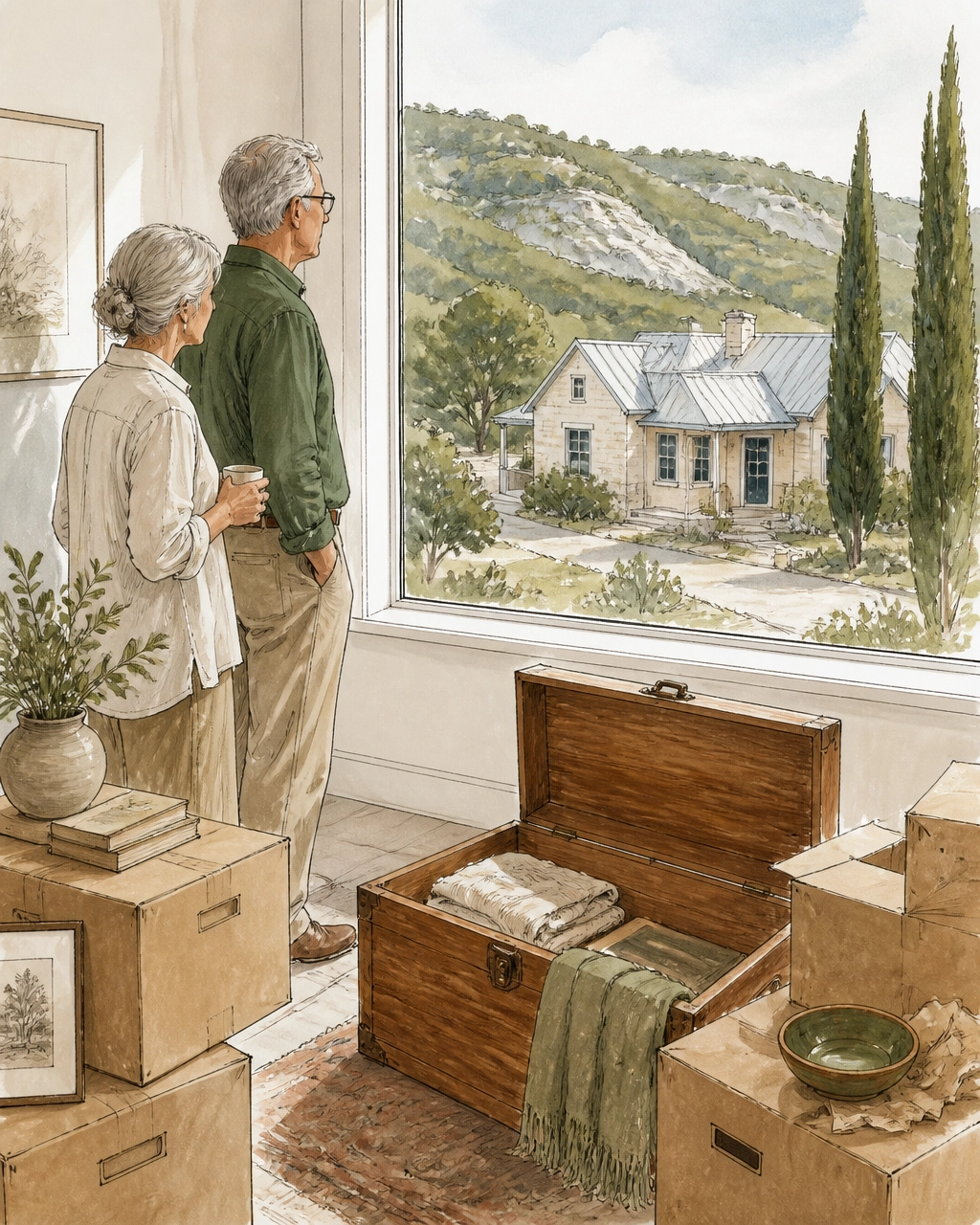
Downsizing for a Wimberley move can be more than a household project. It can be a thoughtful way to decide what belongs in the next chapter of your life.
Moving to Wimberley often represents a shift toward more time outdoors, closer community, creative interests, and a slower Hill Country rhythm. That transition may also mean bringing fewer possessions with you.
For many retirees and pre-retirees, the challenge is not deciding whether to keep a kitchen appliance or an extra chair. The harder questions involve family photographs, inherited furniture, old letters, collections, and objects connected to decades of memories.
A thoughtful approach does not treat those belongings as clutter to eliminate. Instead, it asks what each item represents, whether that meaning can be preserved in another form, and what deserves space in your Wimberley life.
“What deserves a place in the next chapter?”
That question can guide the process without turning it into a race.
Begin With the Life You Want to Live
Before opening closets or pulling boxes from the attic, picture an ordinary day after your move.
Perhaps you imagine coffee on a shaded porch, a walk beneath cypress trees, an afternoon visiting galleries, or an evening with friends near the Square. Wimberley’s appeal is closely connected to nature, community, and creative living. The town’s official parks information describes Blue Hole Regional Park as a 126-acre natural area with trails, picnic spaces, and a spring-fed swimming area beneath cypress trees. Learn more about Blue Hole Regional Park.
Your belongings should support that life rather than compete with it.
Ask yourself:
- Will this item be used, displayed, or enjoyed in the new home?
- Does it fit the way I want to spend my time?
- Does it carry meaning, or am I keeping it from habit?
- Would I choose it again today?
- Is there another way to preserve what it represents?
This is not about creating a perfectly sparse home. It is about making room for the experiences that made Wimberley attractive in the first place.
Sort in Small, Manageable Sessions
Downsizing becomes emotionally exhausting when it is treated as one enormous weekend project. A better approach is to work in short sessions, one category or location at a time.
Start with items that have little sentimental weight:
- Duplicate kitchen tools
- Unused linens
- Old hobby supplies
- Expired household products
- Clothing that no longer fits your lifestyle
- Outdated electronics and cables
These easier decisions help build momentum before you reach the photographs and heirlooms.
A simple four-category system can keep each session moving:
- Keep : Items that are useful, meaningful, or genuinely loved.
- Donate : Good-condition belongings that could serve someone else.
- Sell : A limited number of items worth the time and effort required to list them.
- Recycle or discard : Broken, unsafe, expired, or unusable items.
You may also need a temporary “decide later” category. Keep it small and give it a deadline. A box that remains undecided for months can become another form of storage.
Set a timer for 60 to 90 minutes, then stop. Decision fatigue is real, especially when every object carries a story. Resting before you become overwhelmed can lead to better decisions than pushing through.

Digitize Memories Without Erasing Them
Photographs, family recipes, letters, children’s artwork, and important personal papers can occupy a surprising amount of space. Digitizing them can reduce the physical volume while preserving access to the memories.
Begin by separating photographs into three groups:
- Keep physical : Irreplaceable originals, favorite portraits, handwritten notes, or images with special texture and history.
- Scan and preserve digitally : Items you want to remember but do not need to store in their original form.
- Duplicates or damaged images : Blurry, repeated, or severely deteriorated photographs that may not need to be retained.
When scanning, use a consistent file-naming system. Include names, places, and approximate dates where you know them. A file titled 1987-Family-Reunion-Colorado will be far more useful than one titled IMG_0042.
Consider keeping digital copies in at least two separate locations, such as:
- A computer or external drive
- A reputable cloud-storage account
- A shared family archive for selected photographs
Digitization is not a substitute for thoughtful organization. It simply changes the format. Create folders, label files, and decide who should have access.
You can also photograph larger sentimental objects before donating them. A picture of a well-loved rocking chair, handmade quilt, or collection may preserve the memory even when the physical item cannot move with you.

Give Heirlooms a Destination
Heirlooms often create the most difficult decisions because they connect possessions to people. A dining table may represent family holidays. A silver serving set may recall a parent or grandparent. A quilt may hold the work of several generations.
The question is not only, “Do I have room for this?” It may also be:
- Who would appreciate this item?
- Does someone in the family already have a meaningful connection to it?
- Would a museum, historical group, or community organization be a better home?
- Can the story travel with the object?
- Is it possible to share it rather than store it indefinitely?
Invite family members to look through selected heirlooms while you are still available to explain their history. Avoid presenting every item at once. A smaller, intentional selection encourages conversation rather than competition.
For each heirloom that leaves your home, consider creating a small record:
- A photograph of the item
- The name of the person who owned it
- Where it came from
- Any story associated with it
- The person or organization receiving it
This can turn a difficult handoff into a meaningful transfer of history.
If several family members want the same item, do not assume that the decision must be made immediately. Talk openly, consider taking turns with certain pieces, or find a way to preserve the object’s story for everyone.
Donate With Purpose
Donation can feel easier when you know where your belongings are going. Before beginning, research local organizations whose missions align with the items you have.
Some possibilities may include:
- Community centers
- Faith-based organizations
- Local schools or arts programs
- Shelters and assistance organizations
- Thrift stores that support regional causes
- Libraries or historical groups for books and local materials
Always check current donation guidelines before making a trip. Organizations may have restrictions on furniture, electronics, clothing, or household goods.
Create a “ready to leave” area near the garage or entryway. Once a decision is made, move the item there immediately. Schedule a weekly donation drop-off or pickup so the belongings do not slowly return to closets and spare rooms.
Selling can be useful for a small number of valuable items, but it can also delay the process. Choose a deadline and a limited list. If an item does not sell within that window, donate it or find another practical destination.

Create One Deliberate Memory Space
A smaller home does not require you to abandon sentiment. It may help you contain it.
Choose one defined memory space in your new home:
- A cedar chest
- One bookshelf
- A hallway gallery wall
- A small cabinet
- One archival box
- A designated digital-and-physical memory station
The space becomes a gentle boundary. The items that fit may come with you. Everything else needs another decision.
You can curate a small collection rather than preserve an entire category. Select a few letters instead of every envelope, several favorite photographs instead of every print, or one piece from a larger collection.
This approach makes sentimental belongings more visible and meaningful. Instead of being buried in storage, they become part of daily life.
Let the Transition Take Time
Downsizing can bring relief, sadness, nostalgia, and even uncertainty. Those feelings do not mean you are making the wrong decision. They may simply reflect the importance of the life you have lived.
Give yourself permission to pause. Talk with your spouse, adult children, or a trusted friend. Share the stories behind objects before deciding where they should go. If a particular category feels impossible, leave it for a later session.
Moving to Wimberley does not mean becoming a different person. It means deciding how the belongings around you can support the person you are becoming.
For more on adjusting to the lifestyle shift from an urban environment to the Texas Hill Country, read From City to Country: What Urban Retirees Discover When They Move to Wimberley. Once you arrive, Wimberley’s Newcomer’s Guide to Building a Social Circle From Scratch offers ideas for connecting with the community beyond your household.
The goal is not to own as little as possible. The goal is to keep what matters, release what no longer serves you, and arrive in Wimberley with room for new memories.
Schedule a private meeting with a fiduciary financial advisor today by calling (512) 593-8380 or by visiting: https://calendly.com/portafoliocapital/15min
Portafolio Capital Management dba Mau Sanchez Capital is a Registered Investment Adviser. This content is for informational purposes only and does not constitute investment advice or a solicitation to buy or sell any security. Advisory services are provided only pursuant to a written advisory agreement.
This article may include stories, scenarios, and perspectives created or assisted by artificial intelligence. Although the individuals and circumstances described may be fictional, the topics are intended to reflect real financial, personal, and lifestyle issues that retirees and individuals commonly face.
The content is provided to encourage readers to consider different perspectives that may affect their retirement, regardless of whether they are currently planning, approaching retirement, or already retired. It is intended for general educational and informational purposes only and should not be interpreted as personalized investment, financial, tax, legal, medical, or retirement-planning advice.
Individual circumstances vary. Readers should independently verify any information presented and consult appropriately qualified professionals before making financial or personal decisions. No advisory, professional, or client relationship is created through the use of this website.
Leave a Reply