
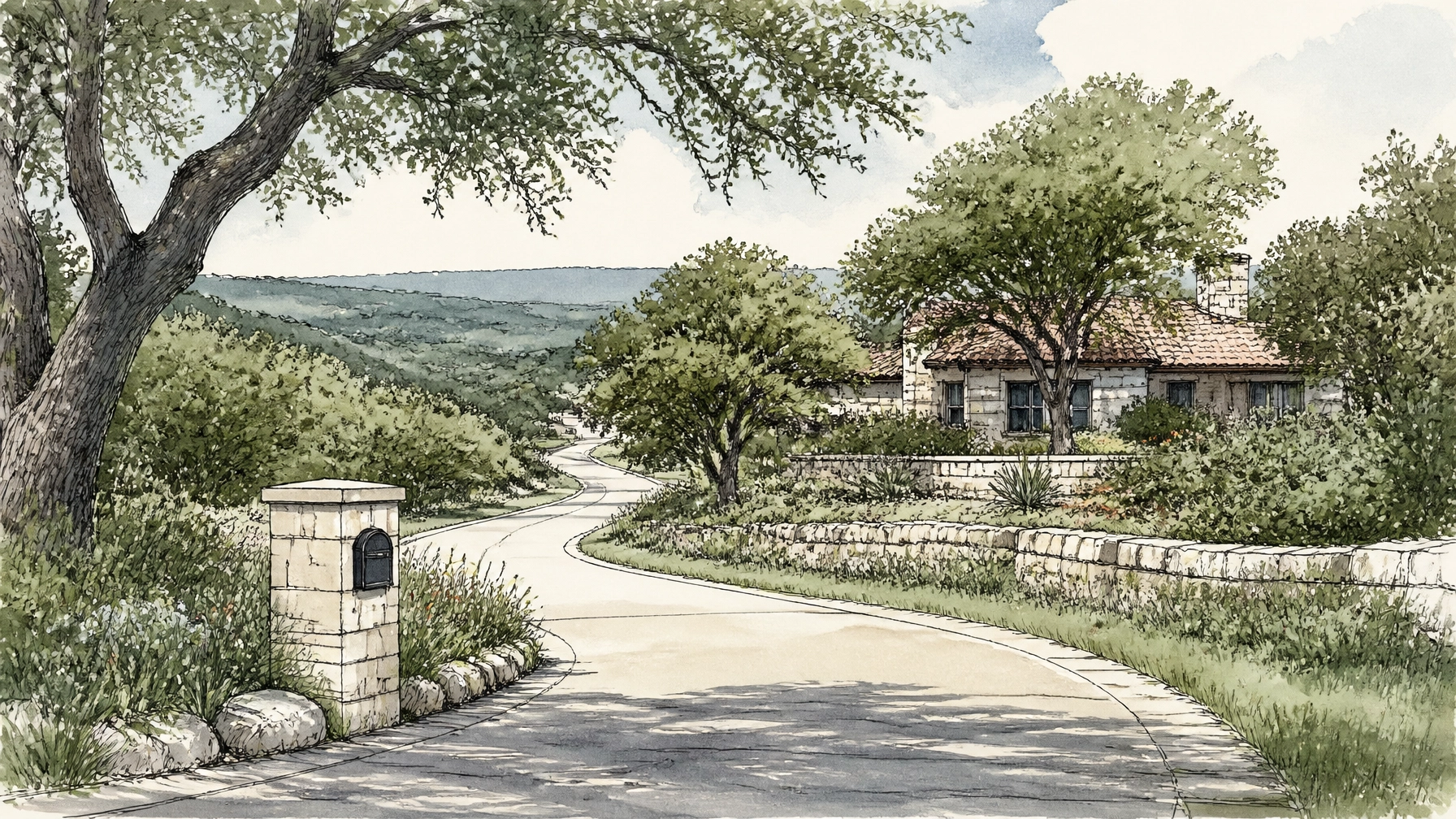
Wimberley is easy to fall in love with during a short visit. But for retirees and pre-retirees, the more important question is not simply, “Do I enjoy Wimberley?”
It is: Where in the Wimberley area would my ordinary Tuesday feel most comfortable?
Beyond the Square, the community changes character from one residential pocket to the next. Some locations offer a shorter drive to groceries, restaurants, and local services. Others provide more privacy, mature trees, and a greater sense of space. Some have a more organized neighborhood setting, while others feel distinctly rural.
That variety is part of Wimberley’s appeal. It also means that finding the right home requires more than admiring a property’s finishes or Hill Country views. You are choosing a daily rhythm.
“A slower retirement is not defined by distance from town. It is defined by how your ordinary days feel.”
Start With the Rhythm, Not the Floor Plan
A beautiful house can still be a poor fit if the surrounding routine does not match your expectations.
Before focusing on countertops, acreage, or guest rooms, imagine a typical week:
- Where will you buy groceries?
- How far will you drive for medical appointments?
- Do you want to see neighbors regularly, or would you prefer more privacy?
- Will you enjoy maintaining a larger property?
- Are you comfortable with rural roads after dark?
- Would you rather have a compact home close to conveniences or a more secluded setting?
Wimberley’s location in western Hays County places it within reach of larger communities such as San Marcos and Austin, while preserving a lower-density Hill Country atmosphere. The City of Wimberley’s community resources provide a useful starting point for understanding local services and municipal boundaries.
For many retirees, the right answer is not the most remote home or the most central address. It is the location that makes preferred routines feel easy enough to repeat.
Three Residential Experiences to Compare
Rather than treating Wimberley as one uniform neighborhood, prospective residents may find it helpful to compare three broad residential experiences.
1. In-town residential living
Some homes near the established center offer a quieter setting while remaining relatively close to everyday destinations. These properties may appeal to retirees who want to remain connected to local restaurants, galleries, services, and community life without living directly in the busiest visitor areas.
The advantages can include:
- Shorter drives for errands
- More familiar routes
- Older, established trees
- Greater proximity to neighbors and local services
- Less dependence on a large property or extensive private infrastructure
In-town does not necessarily mean urban. Wimberley remains small and low-density compared with Central Texas cities. Still, a modest difference in distance can matter as the years pass, particularly if you want to simplify driving or make spontaneous outings easier.
2. Organized residential communities
Areas such as Woodcreek offer a more structured neighborhood environment than many acreage properties. Homes may be closer together, roads may feel more familiar, and community standards can provide a degree of predictability.
This type of setting may suit retirees who want:
- A defined residential identity
- Neighbors nearby without feeling crowded
- Less land to maintain
- A setting that feels easier to understand before moving
- A balance between Hill Country scenery and neighborhood structure
Ask how the community feels at different times of day. A quiet weekday morning may reveal one experience, while a weekend afternoon may show another. Consider traffic, lawn maintenance, short-term rentals, outdoor lighting, and whether the neighborhood feels occupied year-round.
3. Acreage, ridge, and rural-pocket living
For some people, retirement in Wimberley means creating a private retreat among oaks, native grasses, and limestone. Larger lots and rural pockets can offer a strong feeling of independence and quiet.
That privacy comes with responsibilities. Buyers should ask detailed questions about:
- Water source and reliability
- Septic systems and maintenance records
- Internet and cell service
- Driveway access and road conditions
- Emergency response and mail delivery
- Landscaping, fencing, and wildlife
- Distance to groceries, pharmacies, and medical care
Acreage can support a peaceful lifestyle, but it can also create a maintenance schedule. The key is to determine whether the land will enrich your retirement or quietly become another job.

Use the “Ordinary Tuesday” Test
When touring a prospective neighborhood, try to evaluate it without the emotional glow of a beautiful showing.
Imagine waking up there on an ordinary Tuesday in August. The weather is hot. You need groceries. A service appointment runs late. You return home after dark.
Would the route still feel comfortable? Would the house still be manageable? Would you enjoy the quiet, or would you miss having more activity nearby?
Then imagine a different Tuesday in January. The trees are bare, daylight arrives later, and there are fewer visitors in town. Does the neighborhood still feel welcoming and connected?
This test helps separate a vacation impression from a retirement fit.
A home should support the life you expect to live most of the time: not only the weekends when friends visit or the afternoons when the weather is perfect.
Visit More Than Once: and Linger
A listing appointment is not enough to understand a neighborhood’s feel. Plan several visits with different purposes.
Visit at different times
Try to see the area:
- Early in the morning
- Around the end of the workday
- After sunset
- During a weekday
- During a weekend
Listen for road noise, construction, dogs, generators, nearby gatherings, and other sounds that may not be obvious during a brief tour.
Park and walk the edges
You do not need to turn the visit into an outdoor excursion. Simply walk or drive the surrounding streets slowly. Notice whether people maintain porches, wave to one another, walk dogs, or keep largely to themselves.
Look at the practical details:
- Are roads paved, narrow, or gravel?
- Are addresses easy to identify?
- Is lighting adequate?
- Are there shoulders or safe places to pull over?
- Do neighboring properties appear carefully maintained?
- Are homes occupied year-round?
These observations often reveal more than a brochure.
Spend time in the home without the agent
Stand quietly in each major room. Open a window. Notice what you hear. Consider where you would drink coffee, read, host family, or sit during a power outage.
The goal is not to find absolute silence. Hill Country living has its own sounds: birds, wind, insects, road traffic, and occasional equipment. The question is whether those sounds feel compatible with the peace you are seeking.

Separate “Quiet” From “Inconvenient”
Quiet living is attractive, but convenience still matters. A slower lifestyle should not require unnecessary stress.
Create two lists before shopping:
Non-negotiable conveniences
- Maximum preferred drive to groceries
- Acceptable distance to primary care
- Reliable internet for work, family, or telehealth
- Easy access for visitors
- Reasonable road and driveway conditions
Lifestyle preferences
- Mature trees
- A covered porch
- Room for gardening
- Space for visiting family
- A neighborhood association or no association
- Privacy from nearby homes
- A view, creek setting, or elevated site
This distinction can keep a beautiful feature from overpowering a practical concern. For example, a secluded property may have the perfect setting but require more driving and maintenance than you want. A smaller home in a more connected area may provide greater freedom over time.
If you are moving from a city, the transition may feel especially significant. Our guide on what urban retirees discover when moving to Wimberley explores the broader shift from urban convenience to Hill Country independence.
Pay Attention to Water, Elevation, and Infrastructure
The most peaceful-looking properties sometimes require the most careful due diligence.
For homes near Cypress Creek, the Blanco River, or other low-lying areas, review floodplain information before making assumptions about risk. The FEMA Flood Map Service Center allows buyers to research official map information for a specific property. A qualified local professional can also help explain how elevation, drainage, access, and insurance considerations affect a purchase.
For rural homes, ask for documentation rather than relying on general assurances. Confirm the water source, septic history, electrical service, internet options, and any private road arrangements.
These are not reasons to avoid a quiet corner. They are reasons to understand it clearly.

Let the Neighborhood Shape the Retirement Plan
The location you choose will influence more than your address. It may affect transportation, maintenance, utilities, insurance, guest accommodations, and how often you go into nearby towns.
That makes neighborhood selection part of retirement planning: but it does not need to become complicated. A clear plan should account for the lifestyle you want, the costs you can comfortably carry, and the flexibility you may need as circumstances change.
For retirees, that flexibility often matters. A portfolio designed with appropriate asset allocation, transparent publicly traded investments, liquidity, and thoughtful risk management can provide more room to adapt when housing, healthcare, or family needs evolve. The goal is not to add complexity. It is to make the lifestyle decision easier to support over time.
Our article on stress-testing a retirement plan before moving to the Hill Country offers another way to think through the transition.
The Right Corner Feels Livable Before It Feels Impressive
The best Wimberley home for retirement may not be the one with the largest view, the most acreage, or the most elaborate design.
It may be the home where:
- Morning coffee feels natural on the porch
- Errands fit comfortably into the week
- Guests can arrive without navigating a difficult route
- Maintenance remains manageable
- The neighborhood feels peaceful without feeling isolating
- You can imagine staying for many years

Wimberley’s quieter residential corners invite a different kind of evaluation. Instead of asking only whether a property makes an impressive first impression, ask whether it supports the life you want to repeat.
That is where a slower retirement often begins: not with a postcard view, but with a neighborhood that makes everyday life feel calm, comfortable, and genuinely your own.
Schedule a private meeting with a fiduciary financial advisor today by calling (512) 593-8380 or by visiting: https://calendly.com/portafoliocapital/15min
Portafolio Capital Management dba Mau Sanchez Capital is a Registered Investment Adviser. This content is for informational purposes only and does not constitute investment advice or a solicitation to buy or sell any security. Advisory services are provided only pursuant to a written advisory agreement.
This article may include stories, scenarios, and perspectives created or assisted by artificial intelligence. Although the individuals and circumstances described may be fictional, the topics are intended to reflect real financial, personal, and lifestyle issues that retirees and individuals commonly face.
The content is provided to encourage readers to consider different perspectives that may affect their retirement, regardless of whether they are currently planning, approaching retirement, or already retired. It is intended for general educational and informational purposes only and should not be interpreted as personalized investment, financial, tax, legal, medical, or retirement-planning advice.
Individual circumstances vary. Readers should independently verify any information presented and consult appropriately qualified professionals before making financial or personal decisions. No advisory, professional, or client relationship is created through the use of this website.
Leave a Reply